


Click to zoom and read article:
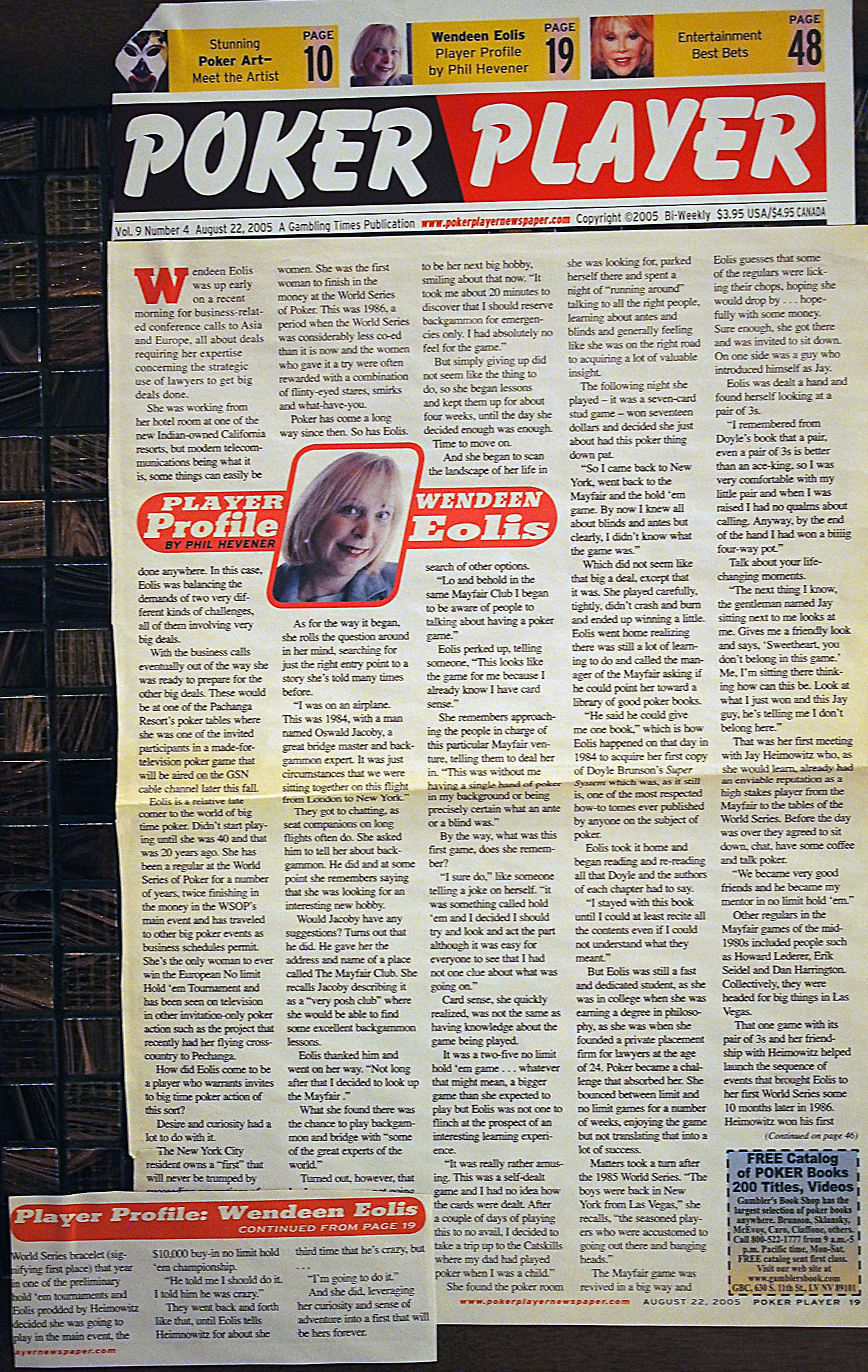
Click to zoom and read article:
Poker Player Newspaper
July 31, 2005
 Two decades ago industrious poker players, Yours Truly among them, wore the covers off WSOP two-time grand champion Doyle Brunson’s Super System and poet laureate Al Alvarez’ Biggest Game in Town.
Super System was quickly revered as the definitive poker text book, and Al Alvarez’s riveting narrative about the players and the action at the World Series of Poker taught and entertained all who populated the poker scene circa 1980.
In those days, I was not yet schooled in poker strategies and emerging theories that authors such as Mike Caro and David Sklansky were bringing to the tables. I also had no inkling that Alvarez’s acclaimed Biggest Game in Town would serve as inspiration for James McManus’ bestseller, Positively Fifth Street, some fifteen years later.
Doyle, Mike, David, and my friends Tom Mc Evoy and TJ Cloutier have been the major authors in my 200 plus book poker library of the last several years. They have stood the test of time, as has Alvarez and James McManus. McManus has sold the movie rights to his tale of murder, Cheetahs and the 2000 World Series of Poker.
At the 2005 World Series of Poker Lifestyles Show, a plethora of biographies, autobiographies, and other poker adventure stories were offered up for sale along with scores of classic and newer “how to ” poker books, of variable merit.
These days, all manner of poker books are happily making their way onto the bookshelves of both mainstream bookstores and specialty distribution outlets.
Among the scores of “how to” tomes, three certain winners are on display. Doyle Brunson’s Super System 2 is a winner of the first order, in no small measure due to the collaborators he chose for the sequel to his original definitive poker textbook.
Once again, he turned to Caro and Bobby Baldwin (the latter is the WSOP champion who turned in his poker jacket to become a top suit), but he also looked to an expanded group of top-notch pros, as collaborators , this time around. The next generation of super stars came on board to join the poker king – his son Todd Brunson and young poker tigers Jennifer Harmon and Daniel Negreanu, among them. Doyle’s latest book is filled with sophisticated poker lessons, but it does not stand alone. The additional standouts this year in the “how to” category, include two formidable players that have mounted the stage as poker teachers extraordinaire.
Dan Harrington’s Harrington on Holdem is a two-volume work that lays out his winning ways in clear and detailed prose. Harrington, in his book, and Barry Greenstein in Ace on the River both underscore the increasingly sophisticated concepts that must be mastered to excel in a modern-day poker world, and they show how important it is to continuously review and refine both technical expertise and individual game plans.
Harrington’s first strategy book was a smash hit among experienced players, and anyone who seriously seeks first place prizes cannot afford to miss his second one either. Co-authored by Bill Robertie, an expert games player, Harrington on Hold’em offers a superb guide for advanced play, but is not beyond the comprehension of lesser skilled players. If you use his words of wisdom, diligently, your game cannot help but improve.
Beyond the world of poker instruction, for which millions of players seem to have an unquenchable thirst, there are three poker adventure books that I suspect will knock your socks off as they did mine. They are as follows: Aces and Kings by Michael Kaplan and Brad Reagan, One of a Kind by Peter Alson and Nolan Dalla, and Michael Craig’s The Banker, The Professor and the Suicide King.
Ace on the River by Barry Greenstein, is, as one might expect, a horse of a totally different color from any other teaching manual.
The unique presentation of complicated material in simple terms and a beautiful assortment of accompanying photographs that are relevant to the text is typical of Barry’s independent and uniquely brilliant perspective about poker, not only in card rooms but far beyond the felt.
In Aces and Kings, you’ll be enlightened about the struggles as well as the brighter side of the most notable stars on the poker planet. Kaplan and Reagan are both gifted writers that bring their subjects to life instantly, and there is something new (and significant) to learn in this book for even the most well informed poker journalists and seasoned players of all ages.
In One of a Kind, Nolan Dalla, who had done a ton of interviews with Stu Unger during the later years of his life, teamed up with Harvard educated writer Peter Alson. Peter transposed the goods that Nolan acquired into a compelling portrait of Unger’s life and tragic death. One of a Kind will challenge you to soak up the pain and learn from it.
In Michael Craig’s in-depth account of the Big Game in which a wealthy Texas banker pits his skills against a “corporation,” brings the reader to the table that saw the highest stakes poker games ever hosted in a public card room. You will be awed by the access and the details he obtained about the assembled players, and the wild games they played. You’ll also learn about the failed plans for the “ultimate poker battle.”
No matter how far and wide you have roamed around the poker world, and no matter how well schooled you may be, the poker books I’ve highlighted here should keep your rapt attention from the first page to the last. Every one of them offers valuable insight into the mind-sets of icons of the poker world, and striking strategy tips for winning at the toughest tables.
Wendeen Eolis is CEO of EOLIS International Group a legal/business consultancy. A longtime confidante and advisor to Rudy Giuliani, she also served as first assistant to Governor George E. Pataki. She is consulted by law firms, companies, and governments around the world. In her spare time Wendeen became a poker ace; she was elected to the WPT’s Inaugural Professional Poker Tour and has cashed in five WSOP events. She has written articles for various law journals as well as the poker industry. Visit eolis.com for info on her book, and availability as a speaker
Poker Player Newspaper
July 25, 2005
Having rolled over 1200 plus players on day one at the 2005 finale of the World Series of Poker, I was one of the estimated 1850 remaining contestants in the competition that boasted 5619 participants at the starting gate, in three separate day one flights. My exuberance, however, was short-lived.
You do not have a monopoly on cracked Aces against an opponent who tries his luck at beating a far better hand. Three minutes into the proceedings, my prospects for a quick double-up turned to extinction. I returned to the pressroom to take stock and begin writing about the richest and most prestigious poker tournament in the history of the game.
Two days before the beginning of the final event, I showed up on the scene, rested and relaxed, and ready to sail into combat. No sooner than I arrived at the Rio’s Convention Center, where the festivities were lodged, the 2005 World Series of Poker quickly revealed itself as a poker event unlike any other I had ever attended. Harrah’s stunning innovation of the WSOP Lifestyles Poker Show has captured a previously unimaginable land of opportunity for savvy players, vendors and media.
Howard Greenbaum, the vice president of specialty games for Harrah’s, talked about how his brilliant idea for a poker trade show “grew legs” inside the Harrah’s organization. He explained that after the 2004 World Series of Poker, he went to Atlanta, Georgia to receive the Horizon award on behalf of the company for the WSOP’s contribution to up and coming sports programming. While in Atlanta, he visited a trade show that sent his head spinning; from there he began his mission to develop such a concept for the poker community.
At first, Harrah’s shunned the idea; however, Greenbaum persisted. Greenbaum gathered steam with the help of Harrah’s marketing and convention executives, that he quickly brought into the fold of his new-fangled thinking. Together they made a credible presentation to senior management. The end result was the 2005 WSOP Poker Lifestyles trade show, that just concluded its mind-bogglingly successful four-day run. The showroom featured 88 exhibit booths in addition to the more expensive booths that were available in prime locations that immediately surrounded the poker tournament room.
While on occasion, scantily-clad ladies seemingly overtook the trade show, leaving one to wonder if this was an adults only bachelor lounge, the larger picture was a remarkable aggregation of serious options, offered by some 88 purveyors that cater to the poker industry. The products ran the gamut-from hundreds of poker books and instructional videos to logo tea-shirts, and all manner of poker apparel, along side finely made poker tables, chips and cards, and poker jewelry that ranged from kitsch to clever.
Naturally, ragingly successful Internet poker sites made big splashes along with a slew of lesser known lights that took places on this extraordinary poker stage, as did a wide range of established and start up poker media that displayed their wares. The WSOP Lifestyles Show has offered an unparalleled opportunity to the cream of the crop.
In one of its most clever moves, Harrah’s decision to block off the fastest access route into the tournament area, diverting poker players’ paths to their competitions so as to pass through the trade show arena was a stroke of genius from the perspective of the vendors that had paid a pretty penny to participate here.
Well-known poker commentator Jessie May set up stakes for one of his daily WSOP shows in the middle of the Poker Lifestyles convention room, inviting yours truly to comment about the extraordinary happening that was enveloping us. “How did this come about?” he asked rhetorically. He prodded me to flesh out the events that have made poker hot as a pistol: the World Poker Tour’s televised poker programming that displayed players’ whole cards as the action progresses, guerilla marketing efforts of select Internet-based poker sites, and the fairy tale win that the aptly named Chris Moneymaker posted at the 2003 grand finale of the WSOP. In my continuing conversation with Howard Greenbaum, in the vast Lifestyles viewing room, I asked about the challenges that faced the Harrah’s team in readying this World Series of Poker for players and media as well as the massive number of poker-related vendors that were in residence here.
Mr. Greenbaum was candid about the need for various improvements, but pointedly impatient with what he considered nitpicky gripes, chief among them my suggestion that there were extensive customer complaints over the limited food comps distributed- particularly the $10 discount coupons that were allotted to each player in the $10,000 event. On the other hand, Greenbaum was quick to assure me that the insufficiency of nearby rest room facilities was a top priority for change next year.
Extending generous praise to the entire Harrah’s team and its outside media relations consultants, TBC, looked like a proud father, noting that only a year ago he had taken on substantial responsibility for coordinating Harrah’s newly owned World Series of Poker. No one with knowledge of the inner workings of the event can deny Greenbaum’s exceptional leadership contribution to the phenomenal success of this year’s WSOP.
Greenbaum has asked each department of Harrah’s that has been associated with the WSOP to participate in a candid critique of this year’s event, in search of useful improvements for next year. Taking me back to the food and beverage issue he had scoffed earlier in our conversation, Greenbaum promised that next year, a wider range of restaurant options will be offered for the use of the food coupons that are distributed to tournament players daily. But Greenbaum also says, “Times are a changing”, and that players who still expect fully comped meals in private dining rooms during this event are out of sync with the reasonable expectations of a public company that has a significant commitment both to its customers and its shareholders, alike.
In addition to catering to vendors and players, this year Harrah’s has had to deal with unprecedented media interest; managing the process has required near super human effort and teamwork between inside and outside media relations personnel. More than 500 reporters sought media credentials amid plans to search out hooks for unique stories.
With a commitment to broaden the landscape of coverage, Harrah’s limited each media outlet to three credentialed representatives and offered a welcome mat to esoteric publications and little known media outlets, with hopes of reaching previously untapped markets as well as expanding the WSOP brand through major media all over the globe.
Occasional complaints of abrasive treatment by Harrah’s media arm TBC notwithstanding, Dave Curley, Director of Media Relations, and the rest of his TBC team managed the process for the most part with extraordinary aplomb. He offered: “At the end of the tournament, we will be happy to reflect upon the policies we instituted this year and how they may be improved upon for next year.” That said, Curley emphasized that for this year he was “committed to developing and enforcing fair rules across the board, and to accommodating as many media outlets as possible.”
As I prepared to take my leave from Harrah’s, Greenbaum informed me that, contrary to rumors that were floating all around, next year’s WSOP will take place once again here at the Rio Suites Hotel. I can hardly wait for another chance at a “life-changing experiences on the WSOP Tournament trail.
Wendeen Eolis is CEO of EOLIS International Group a legal/business consultancy. A longtime confidante and advisor to Rudy Giuliani, she also served as first assistant to Governor George E. Pataki. She is consulted by law firms, companies, and governments around the world. In her spare time Wendeen became a poker ace; she was elected to the WPT’s Inaugural Professional Poker Tour and has cashed in five WSOP events. She has written articles for various law journals as well as the poker industry. Visit eolis.com for info on her book, and availability as a speaker.
Poker Player Newspaper
July 14, 2005
No sooner than the plane touched down on the tarmac at McCarran International Airport in Las Vegas, my mobile phone is afire with messages from players at the 2005 World Series of Poker.
Record fields of tournament entrants are daily occurrences. High-profile poker players are fixated on tournaments that will be televised, and three more poker player associations have been hatched in the WSOP corridors.
 Mike Caro, the “Mad Genius of Poker” and long-time friend whisks me away from the airport with further updates on the exhilarating madness that awaits me at the 2005 World Series of Poker. A full mile away from the main entrance of the Rio suites hotel, site of the World Series of Poker, a jam-packed parking lot hails the arrival of players from across the country and as far away as all four corners of the globe.
I enter the convention center and make a right hand turn into a grand hallway fit for a red carpet affair. Two hundred feet further, a big sign beckons new arrivals: “Register here.” Having been warned that the final event of the 2005 WSOP may be sold out, I have already anted up for the Big Dance through the WSOP online registration program. I have gotten a jump on my procrastinating friends, not only by ensuring that I cannot be shut out, but also by getting my starting day, table, and seat number in advance.
Yesterday’s rumor was that Harrah’s might open the number of available seats for the main event past the previously announced 6,600 places. Could the starting number of punters swell past 8,000? Silently, I note that with more than $700 a head in entrance fees taken off the top of the prize pool for the House, the mega-resort has good reason to figure out how to accommodate every last poker player on the face of the earth who wants to be here!
Journalist that I am, I insist on checking out the rumor with a reliable source. So I tag Ken Lambert, Harrah’s Director of Tournament Poker. He says “no dice” to such chatter, informing me that higher-ups have assured him that there will be no expanded finale. The 6,600 number is firm and to make sure that players will have an opportunity to win seats in satellites at the Rio Suites property right up to the last day, Harrah’s is currently holding out an estimated 1,000 seats, according to Lambert. “From this point on, your best bet for a seat in the Championship Event is a satellite or a super-satellite at the Rio or by using the old-fashioned method of “buying in” for 10 dimes-sooner than later. As of June 23rd, online registration for tournament events has been closed. Going forward, if you plan on playing in a satellite elsewhere between now and July 7th, beware: you could find yourself a winner, but standing on the rail.
Worry-free about such matters, I take a spin through the Rio poker room. It is a ‘never been seen before’ vision: two hundred poker tables under bright lights glisten before my eyes. They stand above plush carpeting with ample space to navigate between tables. The room is immaculately clean. Beyond the sea of faces already at the tables for the $2,500 No Limit Hold’em competition today, I spot TJ Cloutier, the towering ex-football player and long-time player who is still at the top of his game in his sixties. He’s already shown the zillion young studs in attendance here that maturity and experience are valued assets and that it is staying power that brings genuine respect for your game.
In a widening loop around the tables, I note that old-timers seem scarce against the throngs of twenty-something newly minted wannabees. The road-gamblin’ Texans of yore are outnumbered by thousands of recreational players with full-time jobs that only dream of turning pro.
No matter the debates surrounding each and every event until the very last minute, as to the number of players that will sidle up to the table, nothing matches the frenzied private bets among players and tournament staff on the size of first-place prize money for the main event. I push Lambert to make a prediction. He tells me that the optimists are hoping it will hit 10 million. He smiles broadly, but says nothing when I ask if the odds makers are in trouble with the over at 8 million.
Sitting in the middle of the poker room, I eye the tables, the dealers, the crowd, and the ESPN crew that is moving about like a synchronized cast of characters in a play. Ken Lambert and his trusted right hand Johnny Grooms talked to me about this historical moment in the poker world. They give me answers to the right questions even before I pose them.
Rooms at the Rio Suites are still available. As of late, they are selling like hotcakes even though they are double the price of the old Binion’s Horseshoe rate. Ken adds that the $109 tariff on weekday nights and $179 charge for weekends are true bargains compared to the hotel’s year-round rates. Next, Ken schools me about the rules for player sponsorships during this year’s tournaments. He cautions that there will be no repeat of last year’s efforts by certain poker companies to “buy the final table,” offering players the chance to wear their logos for big bucks once they’ve proven their mettle in the event- trying their darndest to make the finalists look like a billboard for their corporate entities.
This time around at the WSOP, players must obtain sponsors prior to the beginning of the tournament in order to wear their logo apparel for televised poker shows. Then they must meet Harrah’s requirements which allow a maximum of a three inch square patch on one visible garment. If you dare to come with more, the excess logos will be taped.
Talking about televised poker action, tournament staff chuckle that the players’ are totally smitten by the chance to play poker on the tube. One dealer mocked the rush of reporters by poker pros, saying, “You’d think that the opportunities to mug for the camera would guarantee a future fortune. “Don’t assume that.” There are a lot of one-stunt wonders out there who get found out pretty quick.” For the time being, however, the press seems as anxious for interviews with players- pros and unknowns alike-as players are for the attention. Everyone is lapping up the current poker madness that reigns here.
Poker players and poker dollars are flying into town at lightning speed, with unknown 21-29 year old males frequently accounting for nearly a third of the field in major events. I can’t help but yearn for the good old days of poker when Jack Binion announced the name of each and every player in the main event as they strolled to their seats, greeting their fellow gladiators by name as they took their places. The poker gods read my thoughts; the elite of the poker world and longtime friends are gathered here this evening for a roast of John Bonetti. The gravelly voiced, tough-talking original from New York has made his mark on the tournament trail, having started down that path at age 65. Bonetti is no quitter. Neither bad streaks at the felt nor a rare and frightening form of cancer could keep this man down. He keeps on cashing. The three-time WSOP bracelet winner has added to his stash another $175,215 with a third place finish in a $5000 No Limit Hold’em event here at the 2005 WSOP.
The belly-laughs at the Bonetti roast come fast and furious with Mike Sexton’s rapid patter setting the tone. Sexton tells the crowd that John Bonetti’s passion for the game has earned him a record number of penalties for uttering the F-bomb word. Sexton doesn’t let up. He points out that Bonetti has the lone distinction of a penalty for use of the f-word during a tournament break, moments after a hand that didn’t please him. And Sexton finishes him off with a claim that dealers keep a dart board on hand in the break room in a lame effort to make mincemeat of the killer poker player.
At the end of the day, however, John Bonetti’s foibles pale in comparison to his heart for the game, his courage in facing life’s trials, and his faithful friendships throughout the poker world. Here, here to the 2005 World Series of Poker and John Bonetti, an old world poker hero, with talent to handle the modern game.
Wendeen Eolis has cashed four times with record-setting performances at the WSOP, including twice in the main event. She has appeared on the WPT televised Ladies Night II event and was elected to the inaugural of the WPT’s Professional Poker Tour. Her accomplishments in business, politics, and poker have been profiled by major print and broadcast media including the New York Times, Wall Street Journal, A & E’s Biography and most recently on the Travel Channel.

The New York Times
July 10, 2005
The other tournament I’m skipping today is the “Ladies” no-limit hold’em event.
Be that as it may, world-class women players like Kathy Liebert, Marsha Waggoner, Cyndy Violette, … Wendeen Eolis, Maria Stern and Maureen Feduniak, all of whom hold their own in open events, showed up at 11 a.m. this morning. At last count, over 600 women had put up the $1,000 buy-in, establishing yet another World Series of Poker record.
Poker Player Newspaper
June 21, 2005
During the past several weeks, scores of poker players have taken their places on the set of the new poker movie, Lucky You, to participate in a piece of modern poker history.
I was part of the crowd, counting the blessing of yet a third tony poker invitation in one week.
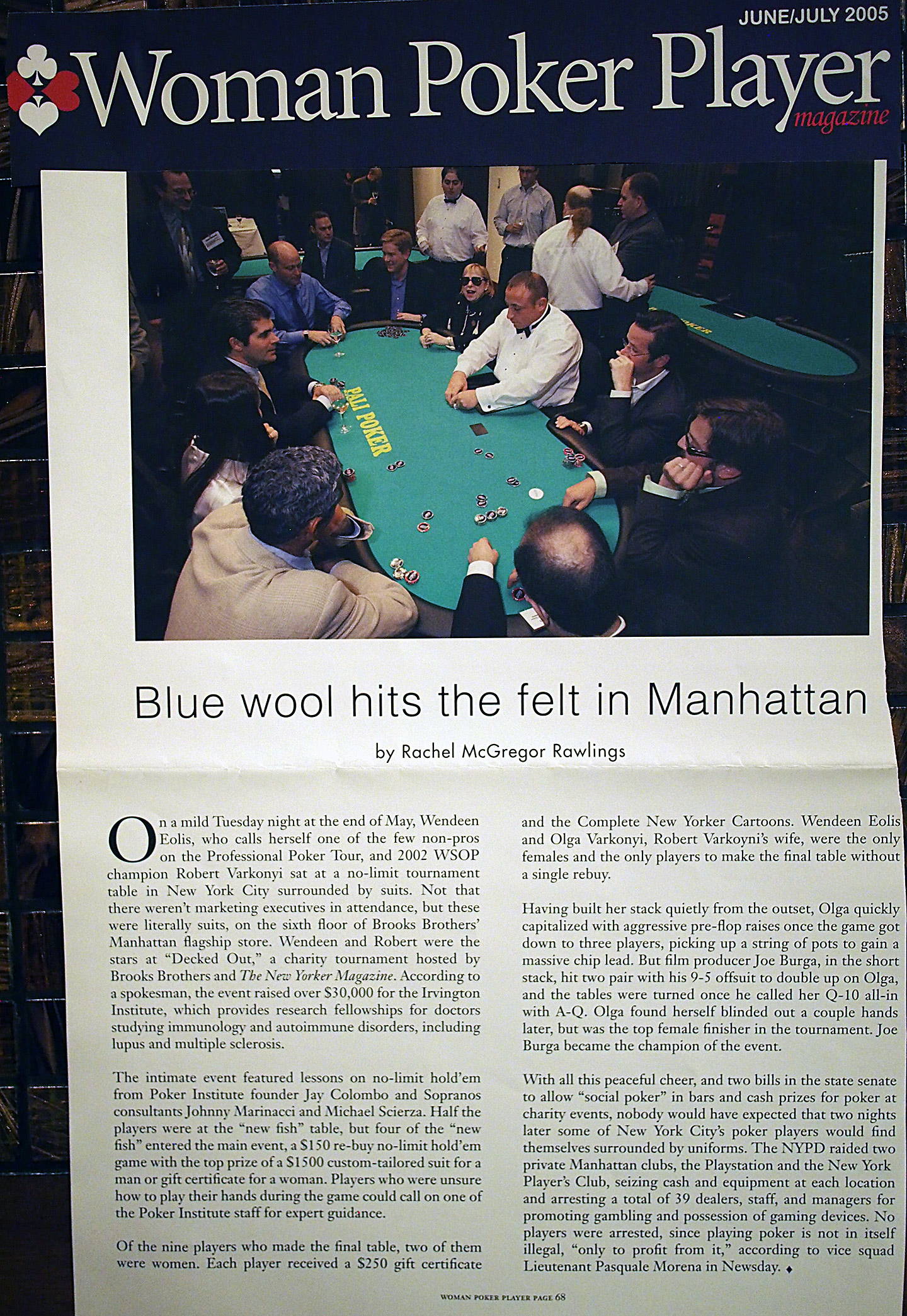
A few days earlier, Jay Colombo, the CEO and Managing Director of the Poker Institute, had called me. Colombo had been tapped to oversee one of the city’s rapidly growing posh poker events- another charity tournament, this time hosted by Brooks Brothers and sponsored by the New Yorker Magazine. My assignment, along with WSOP 2002 Champion Robert Varkonyi, was to meet and greet the guests and to offer up my top ten tips for business executives at the felt tables.
At the appointed hour, I dressed to kill, complete with a new engraved Cartier bracelet that proclaimed my membership on the 2004/2005 Professional Poker Tour (let no one forget that election!). Both Rob and I made it to the final table.
Returning home with a fifth place tournament finish (my proceeds were donated to the Irvington Institute), and two new gigs to teach corporate CEOs the finer points of No Limit Texas Hold’em, I turned my attention to booking flights and rooms for Memorial Day weekend in New Orleans. I planned to make my mark in the Big Easy at the final stop on the World Series of Poker Circuit before it circled back to Las Vegas for the Big Dance at the WSOP.
The game plan was to nail down my seat for the WSOP/ESPN upcoming $2,000,000 freeroll. All I had to do was barrel through the field down to eighteenth place in the final event.
No sooner than I had plunked down the airfare and secured my room, well-known tournament director and West Coast-based poker consultant Matt Savage rang me up with an irresistible but conflicting invitation.
“How would you like to come out to Hollywood, to the set of Lucky You, for an interview with the producer?” Matt asked. Does this mean that you have a role in a movie for me?†I queried.
“Well,” he said, “I am not sure about that, but I can get you a one-on-one with the producer as a member of the press, and you can take it from there.” Whoa, what a story this could be!
Early that afternoon, I dashed off to my hair colorist, to begin putting myself together for the big event. I left instructions at the office to change my travel plans. I was en route to Hollywood… I’d hit New Orleans in due course.
“Cover every bit of the gray, and chunky highlights, please,” I pleaded with Anna, explaining that this poker movie was my once in a lifetime chance of being seen on the silver screen. Noticing that the lady in the next chair was making no effort to hide her interest in our conversation, Anna introduced me to her as a woman with a head for business, politics and poker. I obliged Betsy’s rapid fire questions about every detail of my poker “hobby,” until she stopped in mid-sentence to take a phone call.
Dripping with red hairdye around her ears, Betsy nearly yelled into her cell phone, “I have met the poker player you are looking for! Here, talk to her.”
Betsy turned over the call, after whispering that her brother is an Oscar-winning screenwriter. Five minutes later, I scored my third poker invitation for the week-to meet up in Hollywood with Betsy’s brother for a confab about his next planned screenplay.
I promised to call, but secretly, I hoped that I would be too busy as an actor in Lucky You. The next morning, I was on my way to the Hollywood set of Lucky You. On arrival at “The Lot,” I was immediately ushered to Stage 4 site of the Binion’s WSOP set. I had heard in advance that stunning replicas of the Bellagio and Binion’s Horseshoe poker rooms set the stage for a poker movie with serious intentions. Indeed, the sets were surreal-I yearned for the return of the WSOP at the old Shoe.
The cameras were rolling and Matt Savage was center stage-selected to act the part of a tournament director. Amanda, the film’s publicist, soon gave me an inkling of what was, and was not to come: a few minutes with the producer between takes, and nothing else. Apparently, I was invited here strictly to get a feel for the movie to help me in writing a story.
Using the back corner of the set as our interview office, Producer Carol Fenelon cooed about how lovely it was that I had decided to make the trip all the way from New York, just to do a story about her movie. She then launched into a two-minute vague overview about the film.
When I got my first chance to respond, I explained that I was motivated to make the visit because I believed I might also be included among the pack of players that were invited as “talent.” Carol promptly burst that bubble, explaining that the poker player shoots were already winding down, and that my role would be limited to the opportunity of an up-close and personal look at real life moviemaking, presumably for the purpose of writing of a story. Carol Fenelon is my kind of executive-one who plays it straight, from the get go, even if you don’t cotton to the news.
Carol and her longtime friend and production company partner, Curtis Hansen (who is the director of the movie), have created this confection as a labor of love, with a commitment to turn out an authentic representation of the poker scene circa 2003. The storyline revolves around the relationship between a father and son- both of whom are poker players headed for the World Series of Poker. The cast includes Robert Duval as the father, Eric Bena as his son, and Drew Barrymore as an aspiring singer and the son’s girlfriend. The movie will depict the trials and triumphs in their personal relationships as focused on the resolution of differences within a family. Poker is used as a metaphor to dramatize complex interactions and negotiations among people. The movie will undoubtedly highlight the thesis that poker is a mind-bending game of bets, raises, bluffs and folds that only sometimes is played with cards.
It is a familiar thesis, and the central theme in my own slowly progressing book, Raising the Stakes: Story of a Power Poker Dame. But Carol and Curtis are about to bring this thesis to life now, in all its proven glory, on the big screen. And they are sprinkling into the drama an array of talented poker players as actors, as well as hundreds of actors that form the gorgeous mosaic of poker players that currently mesmerize millions of teenagers as well as adults on televised poker tournaments around the world.
After learning that I had done some homework before meeting with her in our makeshift office- where rehearsals and live takes continued to swirl all around us- Carol switched from surface platitudes about the film to a deeper discussion about its underpinnings. Carol and Curtis have been poker aficionados for more than twenty years, she says. But they became hooked on this project thanks to a chance meeting with Doyle that led to their scoring a quiet invite to watch the “Big Game” at the Bellagio, that pitted Texas banker Andy Beal against Doyle and several compatriots who pooled their financial resources to take on the billionaire businessman. Beal and the Brunson-founded “corporation” became locked in a poker combat of unprecedented proportions; Curtis and Carol held coveted front row seats. The outcome of the Big Game: a moviemaking duo’s fully blossomed passion to make a throw-the-ball-out-of-the-park, full feature, big budget poker movie. Lucky you and me!
For more than two years, Doyle has served as technical advisor for the movie, reviewing the hands, the commentary and the player styles to insure that it all rings absolutely lifelike. Carol says pointedly that this movie is not about gimmicks; no one gets whacked, nor is sex the drawing card. In fact if all goes as planned, the movie will get a PG13 rating, catering to the millions of teenagers as well as adults that thrill to be part of the clattering chip action.
Director Curtis Hansen has spared no effort to create the real McCoy, using more than a score of poker personalities as players in the poker games that are attached to the heart of the movie. In addition to Matt Savage, who has enough speaking lines to make professional actors salivate for the part, Jennifer Harmon, Maureen Feduniak, and Sammy Farha are also reportedly slated for speaking roles. But only the living poker legends Jack Binion and Doyle Brunson have been cast as themselves in the film.
Additional poker players that have been invited to the set, either as consultants, talent, or press, include among others: Kenna James, Dan Harrington, Barry Greenstein, Erik Seidel, Cyndy Violette, Chau Giang, John Juanda, Johnny Chan, Karina Jett, Jason Lester and Marsha Waggoner. Waggoner summed up the general euphoria: “It was a wonderful experience,” adding that she had been given her own private dressing room and was treated like royalty during her four days on the set.
As for Yours Truly, though aspirations to become a character actress in Lucky You were summarily squelched, the silver lining of the visit was clear: I, too, had participated in a piece of modern poker history. In the process, I gained a very personal insight into the creative minds behind the movie. While there is still too little known about the intricacies of the plot to tout the story line as riveting, the hour and a half interview with producer Carol Fenelon left me a believer that the cast, the passion, and the authenticity could spell a blockbuster hit.
Departing from the set of Lucky You, I peered into my handbag and found the telephone number for the screenwriter that had jumped into my life at the hairdresser the week before. Just as I was about to give up, he answered on the fifth ring. I reintroduced myself as the Poker Dame.
“Hi Wendeen, he said. I can’t wait to meet up with you, but I’m on my way to the airport, so let’s talk next week,in New York.”
I’ll be all ears, but once burned, twice shy, so I plan to play coy and let him woo me. There will be no unabashed enthusiasm this time around! And no disappointment if a pipedream goes awry, either.
In the meantime, I’ve given up box office delusions in favor of a ticket for New Orleans. I arrive too late to get into the final event at the last WSOP Circuit event before the 2005 World Series of Poker, but I’ll be on hand in the Big Easy to report about the proceedings.
Next on my poker-playing dance card is the main event of the WSOP, and a chance to fulfill another pipedream,winning the World Series of Poker Championship. Let the poker gods shine down on me, leaving the circuit pros to shriek, “Lucky you!”
Wendeen Eolis has appeared on the WPT televised Ladies Night II event and was elected to the PPT for 2004/2005. She recently appeared as a special guest at the Brooks Brothers/New Yorker Magazine poker evening, ticking off her top ten tips for executives at the tables. Her accomplishments in business, politics, and poker have been extensively profiled by major print and broadcast media including A&E’s Biography.
Poker Player Newspaper
June 6, 2005
As the Harrah’s 2005 World Series of Poker launches, Ken Lambert, longtime card room manager at the Horseshoe Casino in Tunica, Mississippi (a Harrah’s property) is at the helm
– overseeing what are sure to be the most spectacular and chronicled poker contests in the history of the game. And the final event, according to Ken, is likely to see nearly seven thousand runners.
The Golden Age of Poker is upon us, with Ken Lambert on the bridge as legendary old timers collide with a new generation of stars and fearless poker studs and babes who have yet to earn rightful places in poker’s Hall of Fame.
Ken is well known both to the longtime road gamblers and the sharpest twenty- something aces of the game. Raised in Las Vegas, Ken graduated from Las Vegas High School in 1981. He followed in his father’s footsteps into the gaming business, landing his first poker room job at the Frontier Hotel and moving up the ladder. He has held the position as card room manager at Jack Binion’s Horsehoe Casino in Tunica since its opening in 1995, where he oversaw some of the biggest Pot Limit Omaha and Triple Draw games in the world.
When it comes to poker, Ken has seen it all-the days when chewing tobacco and puffing on cigars was A-OK in poker rooms and onward, through the years when casinos paid to get their tournaments shown on television. Ken is at ease in making tough decisions at the tables, and enthusiastic about pleasing reasonable and polite poker players. He is champing at the bit to get off and running in his biggest casino role ever- the management of the 2005 World Series of Poker under the direction of Howard Greenbaum, the Harrah’s senior executive who is a second year veteran of WSOP operations.
Ken is a modest man with Southern charm, more proud of his close knit family- his wife Carole and their three children Jennifer, 14, Christopher, 11, and Brandon, 9- than he is of his considerable accomplishments to date in the golden world of poker.
Ken says that his family will keep him centered on the monumental task of welcoming, managing, and catering to the unprecedented number of poker players that will be jockeying for position daily, in WSOP tournaments and side games with staggering amounts of cash for the poker tables and beyond. Ken says, “I am thrilled to have this job and will work hard to make it the most exciting tournament poker players have ever seen- from start to finish.”
The WSOP has always been the one tournament that meant something to every serious player— the main event, the true cat’s meow. But since 2002 the growth of poker at the WSOP and elsewhere has taken on the sound of an unending roar.
Immediately after the curtain lowered on the 2002 WSOP, the world of poker was forever changed by the birth of The World Poker Tour. The WPT unveiled a new era of poker as a spectator sport, and played a vital role in its stunning trajectory to previously unimagined heights of popularity.
With the fanfare befitting a Fortune 500 corporation rolling out a spectacular business plan, Lyle Berman (Executive Chairman of Lakes Entertainment Inc.) and Steven Lipscomb (President and CEO of World Poker Tour Enterprises, Inc.) cooed to a rapt audience that the WPT was about to put poker on the map like never before. The words sounded like mere hyperbole then, but today no one can deny Lipscomb’s rightful claim that he “has forever changed the face of poker.”
Beginning in the spring of 2003, the WPT’s poker shows transported poker aficionados around the world into the most glamorous card rooms, treating television audiences to the pulsating action and the consequences that surrounded each key hand.
Players were consumed and awestruck by the new method of hand analysis- watching the hands as they progressed, whether in local bars and clubs, family rooms or public poker rooms.
The WPT “lipstick cameras” put the audience up close and personal with the tension and heat of battle, showing not only the hands, but also the faces, of the contenders. This “in camera” technology, adapted from a concept created by toy inventor and poker player, Henry Orenstein, for the UK’s Poker Million Tournament in 2000, turned out to be the key to igniting a full blown poker explosion.
Nevertheless, no one could have predicted, early in its first season, the impact the WPT shows would have on the upcoming 2003 WSOP Big Dance-until it was upon us. In fact, there were plenty of pessimists around at the time, insisting that the number of punters would dwindle, that the fabled WSOP had sadly lost its luster under the controversial management of Becky Binion-Behnen.
But at the opening bell of the final event of the ultimate tournament, an unprecedented 839 entrants filed into the arena (more than a 25% increase over the biggest field in its prior history), setting the record straight about the unstoppable growth of poker.
It is fair to say that the snowballing growth of poker during the spring of 2003 was a product of televised poker and the accelerating player interest in internet-based poker tournaments, a niche that was uniquely captured by PokerStars.com. The feisty newcomer to the online poker community carved out for itself an untapped market of cyberspace poker tournaments, not the least of which included low buy-in super satellites for the “Big Dance” at the 2003 WSOP.
Poker Stars sent thirty-nine players to seek fame and fortune at the felt in Las Vegas that year. Richard Korbin, Marketing Director for Poker Stars, points out that the company sent more than three hundred players to last year’s WSOP and that its numbers will grow exponentially this year. Korbin adds, as if there is someone on the poker planet who does not already know, that both the 2003 and 2004 WSOP champs, Chris Moneymaker and Greg Raymer, respectively, gained their seats and tooled up for the biggest poker competition by playing on the Poker Stars website.
Indeed Moneymaker’s fairy tale story, as it played out not only in the contest itself, but also in an avalanche of print and broadcast coverage by mainstream media, set the poker world on fire. Even before Moneymaker’s magical real name began to cross reporters’ lips during the 2003 five-day festivities, ESPN was planning for an historical event, having decided that the purse in 2002 was big enough to warrant multiple days of coverage of the final event, rather than just the tradition of final table proceedings. Poker fans were destined to get the full Monty! And patent lawyer Greg Raymer’s $5,000,000 payday in 2004 sealed the commitment of multiple television stations to get on the poker bandwagon. Whereas Moneymaker proved the power of cyberspace poker studies, Raymer ran with a different winning recipe— mixing online competition with live tournament adventures and plenty of hours as a weekend poker warrior in live poker games-to take down the championship.
Immensely successful poker show productions (the WPT and WSOP offer full seasons of them) have not gone unnoticed by the pros. By the end of the first year of a televised “poker season” top pros began to press both WSOP organizers and WPT brass to ratchet up their commitments to promote talented and telegenic poker players. WPT and WSOP executives saw the handwriting on the wall- player agents, associations and a push from players to participate in the spoils of these very successful productions. And then Henry Orenstein showed up on the scene with big plans to showcase poker players as celebrities.
The WSOP and WPT folks paid careful attention to the changing poker stage. Henry arrived in Las Vegas with megabucks, ready to jerk the collective chains of WPT and WSOP honchos, while pulling on the heartstrings of top players. He offered up hundreds of thousands of dollars in added monies to entice players into a giant buy-in Invitational event. Ultimately, Henry got the nod for a one-table Invitational that featured a blend of icons, youthful starters, successful “luckboxes” and a couple of “controversial choices.”
Several top players say that Henry’s gambit forced both the WPT and WSOP executives to ponder their future with the “performers” that fund their shows.
In 2004, ESPN blew out its filming of WSOP tournaments to offer a full season of poker tournament shows, complete with a broad cross-section of jazzy player clips at the tables and away from them. ESPN featured not only No-Limit events, but a wide variety of additional poker games (although No-Limit has proven to be the “mother of all poker games” among viewers) on the tube. And no sooner than the tournament was over, Harrah’s and ESPN teamed up to respond to Henry’s ongoing gambits in televised poker with a new one of their own, announcing a “player appreciation” tournament to the tune of a $2,000,000 free roll-for Harrah’s and ESPN’s favorite players among accomplished and popular pros. The notion of giving back to players was firmly planted into the poker landscape.
Not to be outdone, or perhaps smelling more competitive initiatives by Harrah’s, the WPT made a series of titillating announcements about expanded Invitational events. WPT was the founder of the free roll concept, producing an annual Hollywood/Poker Pro Invitational and also tipping its hat to accomplished Ladies on the Tour with an annual Ladies Night show. By the end of the summer, 2004, the WPT was geared up full throttle to create the first Professional Poker Tour-five Invitational tournaments offering a purse of $3,000,000 of pure free roll money-for some 250 elected players.
No sooner than rumblings of a PPT were heard in Harrah’s executive suite, the quick-footed mega-casino moved with its own tour. Participation in the World Series of Poker Circuit Events was and is open to anyone ready to ante up the buy-in. Under Ken Lambert’s leadership with John Grooms managing the operations under him, The WSOP Circuit doles out player points (as outlined in its tournament materials) for money finishes in its events—with a monumental carrot of a $2,000,000 free roll tournament. This time the WSOP cannot be accused of playing favorites. The top hundred point-getters are “all in” for this one.
Traditionally, the WSOP has attracted a gorgeous mosaic of men and women contestants from all four corners of the globe and all walks of life. With the $2,000,000 free roll open to everyone, the WSOP continues to build its brand with emphasis on equal opportunity for fame and fortune based exclusively on how one plays his or her chips. Nowhere, however, will this mantra be more apparent than at the biggest and most prestigious tournament happening in the world- the 2005 World Series of Poker.
Wendeen H. Eolis was the first woman to “cash” in the final event of the WSOP and the first one to do it twice. She has since cashed twice more at the WSOP. She was elected to the membership on the World Poker Tour for the 2004-2005 season and has been seen this year at the final table for the 2004/5 WPT televised Ladies Night 11 event. Her legal consulting company, Eolis International Group, Ltd. reviews law firms and selects counsel, worldwide –for companies, governments, and individuals.

Click to zoom and read article:

Women’s Business
June, 2005
Wendeen H. Eolis, CEO, EOLIS International Group, Ltd.
With the recent ruling awarding 30 million dollars to saleswoman Laura Zubulake who won her sex discrimination case against UBS with the help of subpoenaed e-mail messages, a Pandora’s box of issues is emerging regarding work product privileges in this new age of electronic communications. Many states now have laws requiring employers to preserve all electronic documents, including those generated by their employees on personal business.
If employees are advised, in advance, that e-mail and telephone resources are for business purposes only (except in emergencies), and that for quality control their telephone and e-mail communications may be reviewed (therefore, if they want a private communication, they must separate it from office equipment and office matters), then I think it is fair and reasonable to review telephone, computer, and Blackberry communications that are relevant to the business. The key to the reasonableness of this policy is making it clear in pre-employment interviews and in a personnel policy handbook. Otherwise I would be absolutely opposed.
In our office, employees are so restricted, except with express approval of a supervisor, in which case, for the period approved, their communications are not subject to company review.
More generally, I am opposed to scrutiny of private telecommunications and data on home computers, except where there is genuinely probable cause to believe they are connected to a felony. I believe that the current provisions of the Patriot Act provide overly broad powers to the government with respect to invasion of privacy.
Poker Player Newspaper
May 8, 2005
Introduction: This part of Chapter 7 takes place at the 1988 Binion’s Hall of Fame Tournament. Wendeen, a legal consultant by day, has taken a respite from the stressful role of a crisis consultant to James T. Sherwin, Vice Chairman of GAF Corporation
, a defendant who is fighting Wall Street inside trading charges brought by U.S. Attorney Rudy Giuliani. Her two worlds collide and strong friendships with both prosecutor Rudy and defendant Jimmy are tested in New York, while her poker skills are tested in Las Vegas as the first woman to reach the final table of a major tournament.
“She may look like a kitty cat, but there’s a saber-toothed tiger in there.” –The late Jack Keller, WSOP Champion (In Continental Airlines’ Profiles Magazine, Profile of Wendeen Eolis)
Far away from the stresses of the unprecedented case of The United States vs. GAF, (or, Rudy vs. Jimmy, to me), the poker elite were gathering at Binion’s Horseshoe for the inaugural Hall of Fame Classic. Looking to take a breather in the few days before the trial, I hopped on TWA flight 149 for Las Vegas.
My intention was to socialize, to be seen, and to play a little Pot-Limit Omaha, on the side. Three consecutive winning sessions later, I bought into a satellite qualifier for the $5,000 No-Limit Hold’em main event. Lo and behold I won a seat.
The competition looked tough with the usual suspects parading to their assigned places. There were Texas road gamblers, West Coast commuters, New York undergrounders, a few poker allies from across the pond, and plenty of resident Las Vegas pros. We filled thirteen tables. I was one of five or six women with the guts to mix it up with the boys.
My strategy for day one was survival. It was my first major tournament since the double-barreled break-up, first, with Suds (who was thankfully not at my table), and then with Paul. I was excited about the opportunity to show that I could stand on my own. I planned on playing big pairs and Ace-King without blinking, but I was going to turn down respectable hole cards like Ace-Queen offsuit to a raise, except perhaps in late position. Throughout the first day I edged up continuously, by betting and raising before the flop only with premium starting hands. Catching the Ace-King of spades, I “doubled through” Seymour Leibowitz, the part-time Potamkin car dealer and tournament regular. I felt even better when Berry Johnston, the 1986 WSOP champion, whispered in my ear that he did me the honor of taking out Suds. As day two progressed, I exuded a quiet confidence.
We were down to five tables and my chip stacks had risen nicely, putting me in striking distance of “finishing in the money.” Still resisting the urge to loosen up my play, I continued to jitterbug pre-flop in early and middle positions with only the best starting hands- AA, KK, QQ, AK, and AQ suited- and relied on a few well-placed steals in late position to continue my drive. As the field got whittled down, I reminded myself that if I had a difficult decision about whether or not to call, I was going to fold.
There’s an old maxim in poker that says that any day pocket jacks hold up will be a blessedly good day. I was about to find out what the poker gods had in store for me. I picked up a pair of jacks, and a good ole Texan called my raise. The dealer flipped up 9-7-2 on the flop. The cowboy leaned back as he considered his move.
He asked, in a cocksure voice that made me tremble inside, “Honey, how much more money you got?”
“The dealer can count me down,” I told him.
“Alrighty then,” he replied. “Dealer, count her down.” I stacked my chips neatly in front of me. The dealer let the table know I had him covered. Undeterred, my swaggering opponent said, “Honey, I’m putting it all-in,” as he shoved his stacks toward the center of the table. “Trust me, it feels better in.”
Was he thinking that I was just some sugar daddy’s honey who had no business in this game? That last little lasso of innuendo sealed my opinion about what to do. My two jacks had to be good. He definitely wanted me to fold. That was the perfect reason for me to call, immediately! Forced to show me his hand before I had to show mine, he turned over pocket tens. My jacks won. I quietly pulled in all of his chips. The next guy who came to the table to take the good ole Texan’s seat gave me the eye. Seeing that I had just taken over as chip leader he said, “Honey, I guess we’re going to have to play a pot here today.”
The dealer piped up, “The last guy that called her ‘Honey’ isn’t here anymore.”
One-by-one more seasoned pros fell. The day was going to end when the field was reduced to a final table of ten. Assuming that I did nothing too stupid in the next couple of hours, I figured that I was a favorite to get there. I had just one nagging problem: I was supposed to catch the redeye to New York that night to make it back in time for the opening arguments at Jimmy’s trial the next day. I left the poker room at the dinner break and sprinted ahead of the crowd to the public phone bank near the entrance of Binion’s Horseshoe.
“Hi Jimmy, it’s Wendeen. You’re never going to believe this, but I’m still in the poker tournament, and I have a good shot of making the final table. No woman has ever made it that far in a major tournament before!”
Jimmy had encouraged me to make the trip. He was a well-known gamer himself (twice placing third behind Bobby Fischer in the U.S. Chess Championships), but I had never known him to put extracurricular activities ahead of professional obligations. So, I told him that I was thinking about abandoning my chips (leaving them on the table) and hitting the road.
I insisted, “I could be in court by morning,” This was a dangerous gambit since I had yet to sort out what I would say or do, if he called me down.
Jimmy told me he wouldn’t think of my leaving. He virtually ordered me to stay and play my best game. I was relieved and ecstatic.
Next I called Rudy to let him know how well I was doing.
“Wendeen, that’s wonderful!” he said. I told him that this meant I might not be in court for the opening day of the trial.
“Why that’s even more wonderful!” he exclaimed. “Good luck!”
“Thank you. I gotta go.” I was not amused. En route back to the poker room, a New York Daily News reporter caught up with me. I knew who he was,he’d been working on a story about poker players from New York. He showed plenty of interest in pros like Steven Zolotow, Stiltman, and Suds of course, as well as others like Howard Lederer, Eric Seidel, Mickey Appleman, and Dan Harrington. The reporter previously hadn’t paid me any mind, convinced by some of the Mayfair boys who had been beating up on me earlier in the month, that I was as good as chopped liver at their underground poker tables. But as day two rolled into night, I wasn’t just the only woman still alive, I was the only Mayfair player still in the hunt. Shortly before midnight we were down to the final nine players. I was one of them.
On the third and final day of the tournament, the poker room was overflowing with spectators. Women poured out of the bleachers to wish me good luck. My opponents included the likes of Brad Daugherty, a seasoned pro, two-time World Series Champion Johnny Chan and Phil Hellmuth, a very young “poker brat.” I crippled the twenty-four year-old rising star, an hour into the action, with an Ace-8 suited against his pair of nines.
Right before this hand, I had decided that it was time to adjust my ultra-tight strategy. Shifting gears effectively, however, is more easily said than done. It wasn’t until an Ace dropped on the last card that I was vindicated for my over-the-top, super-aggressive play. My winning pair of Aces put Phil on the brink of elimination.
With seven players remaining, I counted down my opponents’ chips. I was in third place. I realized that if I played my cards right, I could actually take down the championship. Phil bit the dust on the next hand. Down to six, I peeked at the corners of my hole cards and saw a pocket pair. I had two imposing black kings. I was in late position, and knew exactly what to do.
Brad Daugherty raised in front of me, I re-raised, and he called. Three innocent little cards fell on the flop. I knew that Brad was thinking I was a scaredy-cat he could move off almost any hand. No sooner than he bet, I pushed every last one of my chips into the center of the table and announced, “I’m all-in.”
He called.
Ah, ha! Brad showed Ace-Jack. I was way ahead … until an ace appeared on the turn and a jack added insult to injury on the river.
I finished in 6th place and took down almost $20,000 for my three days of work. The women in the bleachers gave me a standing ovation as I got up from the table.
“Another historic finish for Ms. Wendeen Eolis, ladies and gentleman,” tournament director Jack McClelland said over the public address system. I took a moment to soak up the applause, unabashedly euphoric about having yet again smashed through the gender barrier in poker. But the joy was short-lived, as I knew I couldn’t hang around to watch the tournament’s conclusion from the rail. I was shifting gears once again- this time to contemplate the higher stakes poker game that was being played out in the federal courthouse in downtown Manhattan.
As I left the card room, I heard a frantic voice behind me.
“Ms. Eolis, Ms. Eolis!” It was the previously dismissive reporter from the New York Daily News. “How does it feel being the first woman to make it to the final table?”
“Very nice, thank you” I said, stepping lively. I looked back and flashed him a smile and a wave. “Sorry, I have to catch a flight. Good luck with your story.”
Wendeen H. Eolis was one of the six women selected for WPT Ladies Night 11 in 2004, has seven recordsetting performances for a woman in major tournaments to her credit, and is a member of the Professional Poker Tour. By day she is CEO of EOLIS International Group, Ltd, which reviews lawyers and law firms for companies, partnerships and governments worldwide.