

JURY STILL OUT ON WINNERS OF AMERICA'S I-GAMING WAR
Article about Wendeen H. Eolis MIE October 12, 2010
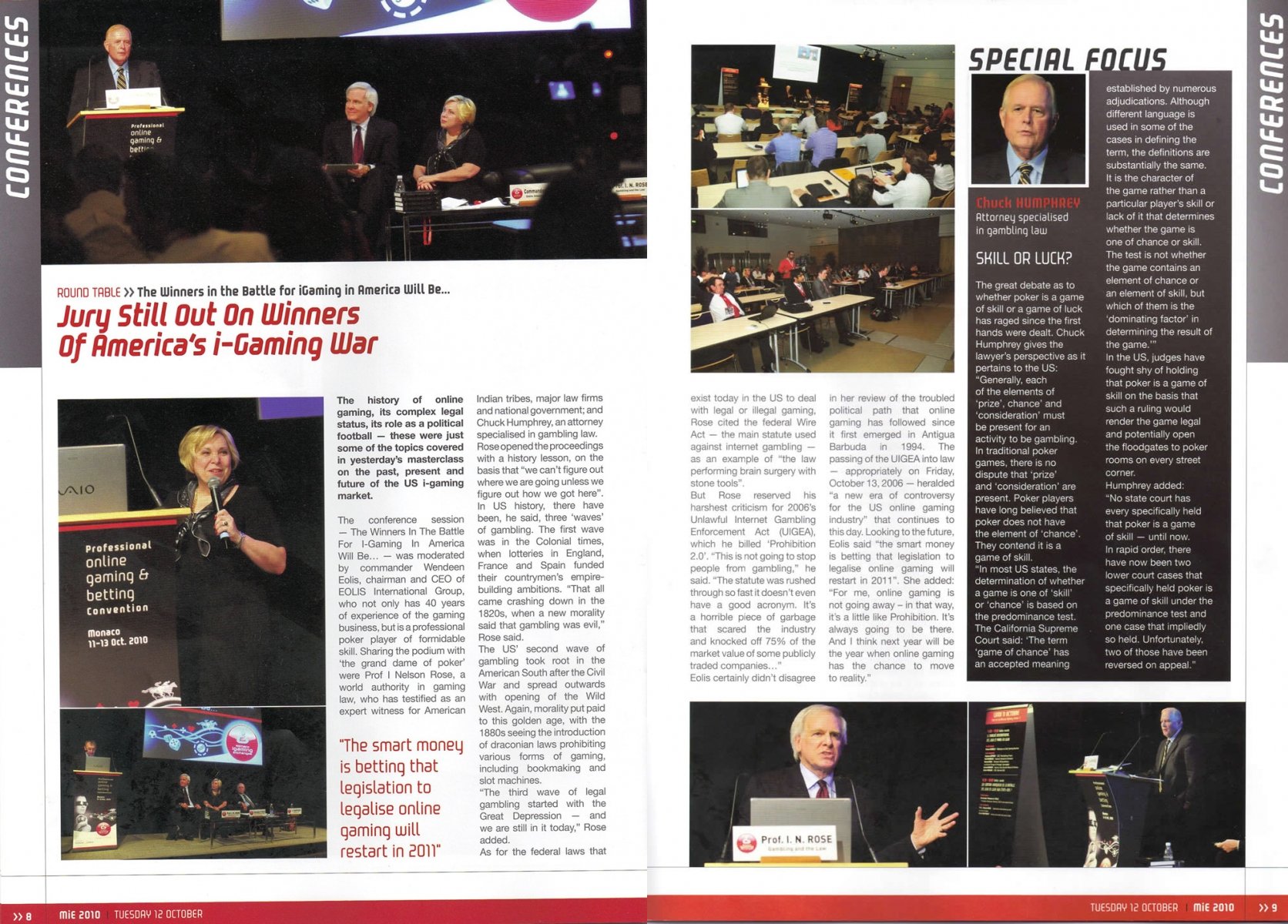
MIE, October 12, 2010
Round Table >> The Winners in the Battle for iGaming in America Will Be…
The history of online gaming, its complex legal status, its role as a political football — these were just some of the topics covered in yesterday's masterclass on the past, present and future of the US i-gaming market.
The conference session — The Winners In The Battle For I-Gaming In America Will Be… — was moderated by commander Wendeen Eolis, chairman and CEO of EOLIS International Group, who not only has 40 years of experience of the gaming business, but is a professional poker player of formidable skill. Sharing the podium with 'the grand dame of poker' were Prof I Nelson Rose, a world authority in gaming law, who has testified as an expert witness for American Indian tribes, major law firms and national government; and Chuck Humphrey, an attorney specialised in gambling law.
Rose opened the proceedings with a history lesson, on the basis that "we can't figure out where we are going unless we figure out how we got here". In US history, there have been, he said, three 'waves' of gambling. The first wave was in the Colonial times, when lotteries in England, France and Spain funded their countrymen's empire-building ambitions. "That all came crashing down in the 1820s, when a new morality said that gambling was evil," Rose said.
The US' second wave of gambling took root in the American South after the Civil War and spread outwards with opening of the Wild West. Again, morality put paid to this golden age, with the 1880s seeing the introduction of draconian laws prohibiting various forms of gaming, including bookmaking and slot machines.
"The third wave of legal gambling started with the Great Depression — and we are still in it today," Rose added.
As for the federal laws that exist today in the US to deal with legal or illegal gaming, Rose cited the federal Wire Act — the main statute used against internet gambling — as an example of "the law performing brain surgery with stone tools".
But Rose reserved his harshest criticism for 2006's Unlawful Internet Gambling Enforcement Act (UIGEA), which he billed 'Prohibition 2.0'. "This is not going to stop people from gambling," he said. "The statute was rushed through so fast it doesn't even have a good acronym. It's a horrible piece of garbage that scared the industry and knocked off 75% of the market value of some publicly traded companies…"
"The smart money is betting that legislation to legalise online gaming will restart in 2011"
Eolis certainly didn't disagree in her review of the troubled political path that online gaming has followed since it first emerged in Antigua Barbuda in 1994. The passing of the UIGEA into law — appropriately on Friday, October 13, 2006 — heralded "a new era of controversy for the US online gaming industry" that continues to this day. Looking to the future, Eolis said "the smart money is betting that legislation to legalise online gaming will restart in 2011". She added: "For me, online gaming is not going away – in that way, it's a little like Prohibition. It's always going to be there. And I think next year will be the year when online gaming has the chance to move to reality."