

Making Deals: Mergers and Lateral Hires
Wendeen Eolis discusses law firm mergers, culture and lateral partner hiring in The American Lawyer, 1988.
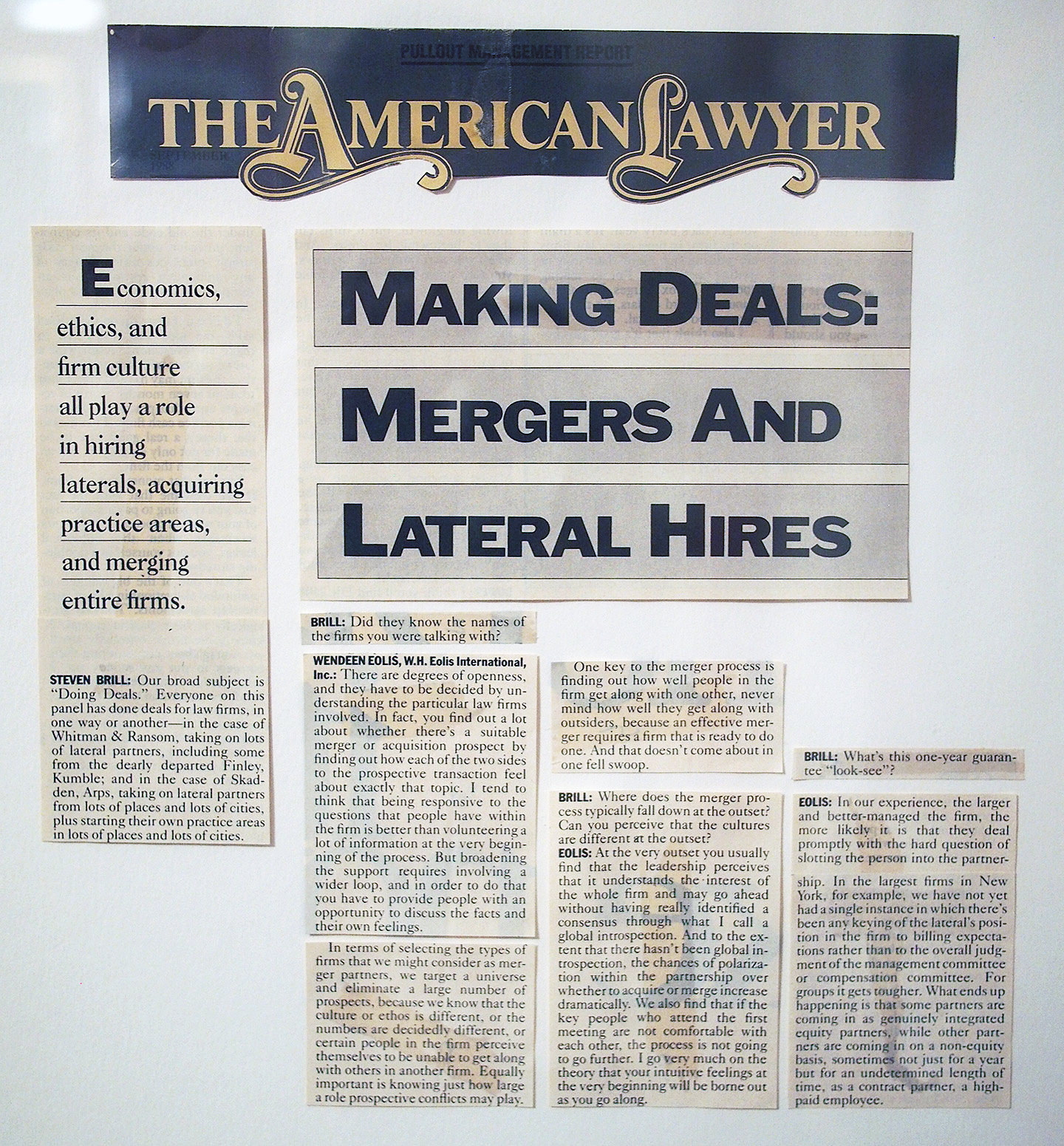
The American Lawyer, 1988 — Pullout Management Report
Economics, ethics, and firm culture all play a role in hiring laterals, acquiring practice areas, and merging entire firms.
STEVEN BRILL: Our broad subject is ‘Doing Deals.’ Everyone on this panel has done deals for law firms, in one way or another—in the case of Whitman & Ransom, taking on lots of lateral partners, including some from the dearly departed Finley, Kumble; and in the case of Skadden, Arps, taking on lateral partners from lots of places and lots of cities, plus starting their own practice areas in lots of places and lots of cities.
BRILL: Did they know the names of the firms you were talking with?
WENDEEN EOLIS, W.H. Eolis International, Inc.: There are degrees of openness, and they have to be decided by understanding the particular law firms involved. In fact, you find out a lot about whether there’s a suitable merger or acquisition prospect by finding out how each of the two sides to the prospective transaction feel about exactly that topic. I tend to think that being responsive to the questions that people have within the firm is better than volunteering a lot of information at the very beginning of the process. But broadening the support requires involving a wider loop, and in order to do that you have to provide people with an opportunity to discuss the facts and their own feelings.
In terms of selecting the types of firms that we might consider as merger partners, we target a universe and eliminate a large number of prospects, because we know that the culture or ethos is different, or the numbers are decidedly different, or certain people in the firm perceive themselves to be unable to get along with others in another firm. Equally important is knowing just how large a role prospective conflicts may play.
One key to the merger process is finding out how well people in the firm get along with one other, never mind how well they get along with outsiders, because an effective merger requires a firm that is ready to do one. And that doesn’t come about in one fell swoop.
BRILL: Where does the merger process typically fall down at the outset? Can you perceive that the cultures are different at the outset?
EOLIS: At the very outset you usually find that the leadership perceives that it understands the interest of the whole firm and may go ahead without having really identified a consensus through what I call a global introspection. And to the extent that there hasn’t been global introspection, the chances of polarization within the partnership over whether to acquire or merge increase dramatically. We also find that if the key people who attend the first meeting are not comfortable with each other, the process is not going to go further. I go very much on the theory that your intuitive feelings at the very beginning will be borne out as you go along.
BRILL: What’s this one-year guarantee ‘look-see’?
EOLIS: In our experience, the larger and better-managed the firm, the more likely it is that they deal promptly with the hard question of slotting the person into the partnership. In the largest firms in New York, for example, we have not yet had a single instance in which there’s been any keying of the lateral’s position in the firm to billing expectations rather than to the overall judgment of the management committee or compensation committee. For groups it gets tougher. What ends up happening is that some partners are coming in as genuinely integrated equity partners, while other partners are coming in on a non-equity basis, sometimes not just for a year but for an undetermined length of time, as a contract partner, a high-paid employee.